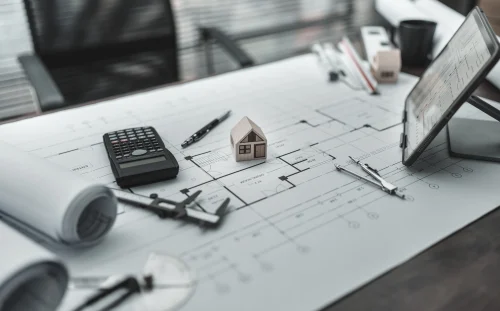
Starting construction without the necessary permits can lead to the suspension of the project, significant financial penalties, and even the demolition of what has been built. Understanding the licensing process is not just an administrative formality, but an essential step to ensure the structural integrity and legality of any building.
At personalHOME, we explain the complete process for obtaining construction licenses and permits.
Required Documentation
The required documentation may vary depending on the type of work and the applicable regional or municipal regulations. However, in the case of a major new construction project, the standard documentation is usually structured into the following sections:
· Basic project and execution project: prepared and certified by a registered architect. Includes report, drawings, and budget.
· License application: standardized form submitted to the city council, signed by the owner and the technician.
· Proof of ownership or rights: public deed, land registry extract, or contract proving ownership of the land.
· Geotechnical study: mandatory for new construction. Determines soil characteristics and foundation requirements.
· Environmental impact assessment: required in protected areas, large industrial sites, or classified activities.
· Fire protection project: necessary for public-use, industrial buildings, or those exceeding a certain height.
· Accessibility plan: justification of compliance with CTE DB-SUA and accessibility regulations.
· ICIO self-assessment: tax on Constructions, Installations, and Works. Paid upon application.
Step-by-step process
The administrative process for obtaining a major construction license typically follows several stages. Timeframes are indicative and may vary depending on the municipality and its administrative workload.
01 – Preliminary consultation and urban planning certificate
Before starting the project, it is advisable to request a report from the city council or the urban planning department confirming land classification, permitted uses, buildability, maximum heights, and required setbacks.
02 – Project commissioning and drafting
Once the urban planning parameters are defined, the architect prepares the basic project, which is necessary to apply for the license, and subsequently (or in parallel) the execution project. It is important to understand the difference: the Basic Project is sufficient for the City Council to say “yes, you can build that,” but the Execution Project ensures that the building is safe and functional. From the outset, it is advisable to involve a technical architect and a health and safety coordinator to ensure optimal planning.
03 – Official approval of the project
In Spain, projects must be certified by the corresponding Official College of Architects. This procedure verifies the identity and qualifications of the technician, as well as the proper formal submission of the document.
04 – Submission of the application
All documentation is submitted to the city council registry, either in person or electronically. At this stage, the provisional ICIO tax and, where applicable, technical review fees are paid. Finally, a file number is assigned.
05 – File review process
Municipal technicians, such as architects and legal services, review the submitted documentation. If they find errors or omissions, they request corrections through a formal notice, granting the developer a deadline to provide the necessary information.
06 – Sectoral reports
Depending on the type and location of the project, it may be necessary to obtain reports from external bodies such as water authorities, road agencies, coastal authorities, heritage departments, environmental agencies, or fire services.
07 – Resolution proposal and approval
If the project meets all requirements, the municipal technician issues a favorable report and the competent authority (government board, mayor, or delegated body) grants the license, including conditions, start and completion deadlines, and other requirements.
08 – Notification and collection
The developer receives the license and may begin construction, notifying the city council and providing details of the contractor, liability insurance, and, where applicable, the waste management plan.
In summary, obtaining a major construction license is a rigorous process that requires technical precision and knowledge of local regulations. Having an experienced team not only avoids penalties and unnecessary delays, but also ensures the technical feasibility of your investment.
If you want to ensure the success of your construction project from the very first document, request a consultation with our technical team today.