The real estate market in Spain is facing an unprecedented structural challenge: a cumulative housing shortage that the Bank of Spain estimates at around 600,000 homes needed to meet existing demand, combined with little or slow growth in new residential supply. With the rate of household formation significantly outpacing the annual number of new building permits, the pressure on the sector to build more and faster has become unsustainable under traditional construction models.
If you have requested a quote for a construction or renovation project in recent years, you have probably noticed that prices have risen considerably. Since 2019, construction costs have continued to increase, driven by this structural imbalance between supply and demand. In this article, personalHOME examines the key reasons behind these rising costs and explains how operational efficiency and advanced construction solutions are emerging as essential alternatives to make residential development in Spain economically viable.
Why Are Construction Costs Rising So Much?
Behind this steady increase lies a combination of structural and cyclical factors that reinforce one another:
1. Shortage of Skilled Labor
The lack of generational renewal and the low number of young people entering the construction industry have created a severe shortage of skilled workers. This bottleneck not only drives up direct labor costs but also extends the average duration of construction projects, increasing indirect expenses and financing costs.
2. Material Prices Have Settled at High Levels
Although the sharp price increases seen after the pandemic and the outbreak of the war in Ukraine have eased for certain inputs, key raw materials—such as steel, concrete, timber, and copper—continue to trade well above their historical averages. Stricter environmental regulations and high energy costs continue to keep material prices elevated.
3. Geopolitical and Energy Volatility
Macroeconomic uncertainty, disruptions along international logistics routes, and changes in tariff policies continue to create ongoing volatility in the supply of construction components. For developers and contractors, this unpredictability translates into higher risk premiums being built into project budgets and contractual pricing.
4. More Projects Underway, Greater Pressure on Prices
Spain’s urgent need to build more housing is placing additional strain on an already overstretched construction sector. According to the fundamental law of supply and demand, when market demand far exceeds available production capacity, the cost of scarce resources—both materials and labor—naturally rises. Strong demand is competing aggressively for limited construction capacity, making this far more than a temporary phenomenon. Instead, it is establishing a new cost baseline in the real estate market that is unlikely to return to pre-pandemic levels.
What Can We Expect Over the Coming Years?
Industry forecasts suggest that cost pressures will remain a defining feature of the market in the medium term. Pent-up housing demand will continue to drive activity, while the technical and operational limitations of traditional construction methods will prevent any significant reduction in project costs. In this environment, the viability of residential developments will increasingly depend on process optimization, digitalization, and rigorous control of construction timelines.
Industrialized Construction: A Progressive and Imminent Solution
Faced with the rigidity of traditional construction methods, industrialized construction is emerging not as a futuristic concept, but as an immediate and steadily advancing solution that is reshaping the industry.
Although the transition to fully industrialized construction (with buildings manufactured entirely in factories) still requires further development and greater scale, the phased integration of industrialized systems and components has already become standard practice in modern residential developments:
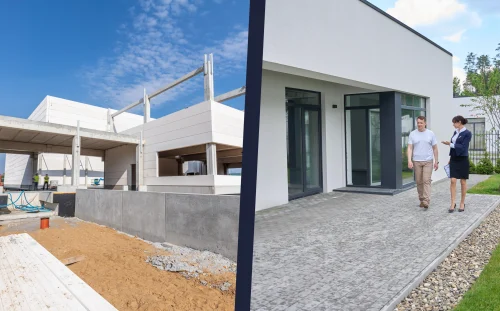
- Structural Systems and Facades: The use of precast concrete panels, light-gauge steel framing (steel frame), and industrialized building envelope systems allows the building shell to be completed in a fraction of the time required by conventional construction.
- Industrialized Modules (Kaths & Pods): The integration of fully finished factory-built bathrooms and kitchens, assembled on-site, streamlines the most complex stages of construction and those requiring the greatest concentration of specialized trades.
This transition toward off-site manufacturing processes offers significant advantages: it drastically reduces reliance on labor-intensive on-site work, shortens project delivery times by as much as 30–50%, minimizes construction waste, and ensures consistently high quality standards.
For the personalHOME team, progressive modular industrialization is not merely a technical evolution but the most robust path toward increasing construction capacity, mitigating cost volatility, and making a meaningful contribution to reducing Spain’s housing shortage.